Content on this page requires a newer version of Adobe Flash Player.

Get Adobe Flash player

With over 30 years in professional show-business, David Cangelosi is known industry wide as one of its most versatile performers. The internationally acclaimed opera singer is also well versed in the areas of musical-theater, night club/cabaret, voice-overs, and his continuing career in the classical vocal arts as a recitalist, master-class instructor, and symphonic guest artist.
Click here to read more.

Keep up to date with "everything Cangelosi" by following him on Facebook or Twitter.

Making History: Dallas Opera–and a decades old production!!

April 23rd, 2012

With each breath and step we take, a sliver of history is created: Micro-history, I like to call it.  Macro-history, however, is created via demonstrable over-arches that bend the arc of narrative…at least, and until–in the case of records–they are replaced.

Such will be the case later this week when the Dallas Opera steals most of the fine-arts thunder nationwide, when it simulcasts a ‘live feed’ of its current production of The Magic Flute on Saturday April 28, 2012 .  With well over 30,000 expected to attend the event at Cowboy Stadium (5 times higher than the original block of seats allocated), it will for certain become the most attended live operatic simulcast in American History…at least for now.

The introspect here–when examining perspective–is that history is about to be made thanks to, well…history!  The decades old, ever audience/family friendly, almost vaudevillian August Everding production of Flute (originating at the Lyric Opera of Chicago) seems to be the perfect vehicle to drive those 30-some-odd-thousand people to the stadium.  If Mr. Everding were alive (having worked with him on this production myself), I am sure he would be delighted that the history making production he created so long ago was going to be creating history anew.

Mr. Everding was an affable man to my recollection; quick to smile, broad of thinking, but always on the cutting edge.  His equally momentous, but now somewhat dated, staging of the Ring brought us trampolines, bungee cords, and neon lighting…’tres au courant’ for the late 80′s and early 90′s.  He never did, however, lose sight of the ‘humanity of characterization’; something that is profoundly important in this particular Magic Flute.  Faithfully remounted but somewhat revised over the years by Matthew Lata, I find it a real treat (and challenge) to revisit ALL of the characters (not just my own) in this rollicking, funny, timely,–and yes–poignant story telling of Mozart’s final opera.

Please remember: We are here to entertain and charm an audience; as well as convey a tale of maturation, fidelity, love, and indeed discord.  Mr. Lata has one golden rule of directorial advice that he provides to himself: “Never argue with an audience response.”  Well if that’s the case, then this past weekend’s opening at the Winspear Opera House is a giant (Texas sized stadium) success.  With a cast of Mozartean greats, and greats to be; this overall event will surely result in a clamor among Opera Company Administrators all across the country, where the eye on the prize will be: “How can we top what they just did in Dallas??”

This should be fun; and will again give new meaning to the old show-biz adage, “It takes 20 years to become an overnight success”!!!

djc

P.s. I would like to thank Gene (and Jerry) Jones, owners of the Dallas Cowboy’s Football franchise, as well as Phil Whitfield (docent) for the personal and OUTSTANDING tour of the facility.  It was a real pleasure to see a stadium so filled with fine contemporary art, and superb seating for all the fans!  I only regret not being able to actually SEE the Opera Simulcast, since I will be performing as a part of it, of course!!!  The HD feed on a screen that is over 70 feet tall, and 60 yards wide, will be a real eye popper for the 35K-40K that attend The Magic Flute over hot dogs/beer/soda.  Mozart would be so proud!!!


A Steady Diet of Bach (A Dallas Symphony Orchestra/St. Matthew Passion experience: March 29, 2012)

March 30th, 2012

As an undergraduate music student at Baldwin-Wallace College (now Baldwin-Wallace University) in Northeast Ohio, we were force-fed an unrelenting amount of music by, arguably, the greatest composer to have ever lived, Johann Sebastian Bach (just don’t tell Mozart or Beethoven…and for goodness’ sake, don’t breathe a word to Wagner!).  The B-W Conservatory of Music was almost irrationally obsessed with Bach, and by default, the music of the Baroque period in general; with everyone in lock step…well, almost everyone.

I cannot keep writing, however, without giving this institution the appropriate “props”.  It boasted an incredible faculty in the 70’s and 80’s, maintained one of the finest “critical edition” libraries of archive worthy music–including rare, original Bach manuscripts; produced a regular scholarly publication (“The Bach Journal”, as we referred to it); possessed an incredibly supportive administration; provided a top-notch musical education; and continues to host one of the most critically acclaimed Bach Festivals in the world…this year celebrating their 80th annual.

Without trying to push a food metaphor unfairly; too much Bach in school was like being fed too many bitter greens when you were a kid (kale and broccoli di rabe come to mind).  Then you grow up!  That which you hated when you were a kid, becomes a craving that simply cannot be denied as an adult!!

Enter: Bach’s most enduring and greatest masterwork, the Saint Matthew Passion (BWV 244).  (I KNOW, the great musical minds over the centuries have decided that the Mass in B minor (BWV 232) is superior.  I respectfully disagree, based mostly upon my love for the theatrical component that The Passion employs.)

The 1727 exposition of Chapters 26/27 of the Gospel according to St. Matthew (for double chorus, solo voices, as well as double orchestra) was/is being presented this weekend in dignified fashion by the Dallas Symphony Orchestra under the baton of Jaap van Zweden.  To wit, the Maestro rarely missed the opportunity to direct his soloists and instrumentalists toward the exquisite art of “text painting”—something that is rarely alluded to in critical commentary.  Bach was perhaps music’s greatest executor of this compositional technique.  It’s true magic to be discovered in moments when it is virtually undetectable to the ear, or at least secondary to other primary melodies.  Bach often “buried” these intricacies for the greater good of the whole, while others are wildly stark and unmistakable.  The genius of Bach is that he knew exactly when to hit us over the head (“Barrabam”–choral exclamation), and when to quietly withdraw (Aus Liebe will mein Heiland sterben—soprano aria), all within the construct of superb musical design.   A series of interlocking recitatives, arias, choruses and chorales are woven into one seamless fabric, with the occasional reach-back to employ classic Renaissance dissonances that provide a necessary splash of tonal color (So ist mein Jesus nun gefangen).  Theatrically speaking, the Passion is a work where matters of the physical, metaphysical, and the spiritual, are joined, separated (“The spirit is willing, but the flesh is weak.”) and joined again as the drama reaches its climax.

The evening unfolded nicely and the addition of a children’s chorus–an often underutilized performance practice–was a nice touch, as they added their voices to the adults as natural spectators.  I must admit, however, that witnessing 41 children sing the words “He bore all our sin…” was especially heartbreaking.  With one exception (who did improve as the evening progressed), the vocal soloists were all top grade, with Camilla Tilling and John McVeigh as particular standouts.  McVeigh’s Part II aria Geduld being especially well delivered.  Concertmaster Alexander Kerr lent his considerable virtuosic talents to Jennifer Johnston’s gorgeous rendition of Erbarme dich, resulting in a half-swoon of pure satisfaction from a nearby audience member upon completion.  Alastair Miles (bass) provided serene relief late in the game with the touching aria Mache dich, mein Herze, rein. The chorus was well prepared and took the roles of angry mob and sympathetic believers well in hand.  The Passion is a solemn work, heavy-laden with poignancy, and Mo. van Zweden never lost sight of this; conducting with pathos and insight throughout.  The moment of Christ’s death, and the quiet, dignified lying of his body in the tomb were highlights certain.

The original German language, with its natural textures and depth of assortment regarding delivery (trust me, I AM an expert on this issue) provides the perfect vehicle for transmitting the vicious, as well as the most gentle and plaintive of moods.

I knew when we performed all of Bach’s major works at Baldwin-Wallace, and witnessed other great Baroque works executed by highly acclaimed, world class artists, that it was good for me.  I never would have expected, however, that my appetite could hardly be satisfied for this fare later in life.  The Dallas Symphony performance—while certainly a full, gourmet meal—seemed only an appetizer for such a hunger.

I busy myself professionally in Dallas (when I am here) with a full plate of opera–being an opera singer of course–as we ready The Magic Flute, and La Traviata for presentation at the new Winspear Opera House–right next door to the Meyerson Symphony Center.  The Dallas Opera will toast to its own bragging rights soon, as it will present its wonderfully cast Magic Flute in a live simulcast at Cowboy Stadium on April 28 to an already sold-out crowd.  But this Palm Sunday weekend is The Dallas Symphony’s chance to shine, and it is doing so in vast array.

While the Dallas arts community, like all others nationwide, is addressing the delicate issue of funding via slightly shorter seasons, fewer performances, contract concessions, and reduced staffing; it is still ‘beyond-incredible’ to be at the center of an arts universe that presents Bach, Verdi, and Mozart side by side (not in competition with, but as complements to one another) in this rather incredible Texas town.

Yes, Dallas may be considered a major city worldwide; but its residents, corporate stewards, philanthropists and arts donors are so down-to-earth and community friendly, you would swear you were in Any-TOWN, U.S.A.; and a ‘town’ is a nice place to be these days.  And while Dallas has gone through celebrated boom/bust cycles since its founding; it is surely a blessing to note that its arts community is just as active as its sports community in leading the way back.

djc

Jaap van Zweden, conductor
Camilla Tilling, soprano
Jennifer Johnston, alto
Johannes Chum, tenor
Morgan Smith, baritone
John McVeigh, tenor
Alastair Miles, bass

(Please note for the sake of good order:  I do not, have not, and do not expect to perform with the Dallas Symphony.  This article is solely based upon my thoughts after attending the Thursday March, 29 2012 performance of J.S. Bach’s St. Matthew Passion, at the Meyerson Symphony Center, Dallas TX.)

“You can’t go home again”…or “CAN you”?? (A Visit to ‘Normandy High School’)

March 23rd, 2012

On this 23rd of March, I sit in the living room of my corner-unit residence in Chicago.  With over-sized windows that feature Gotham City views, I watch the rain come down, as well as witness the fog engulf the downtown skyline in which my own building is nestled.  I think about my other home in NYC where a Metropolitan Opera colleague is currently staying, eager to go back next season to participate in the new Ring Cycle.  But these are fleeting thoughts of the current, and the future; when in actuality I am being constantly drawn back to the events of the last 22 days, which include the now mad dash to sign my tax forms, pay next month’s bills, and get packed to head to Dallas for my next work assignment.

The beginning of the month was marked by the biggest, busiest, and most successful Vann Vocal Institute (Montgomery, Alabama) that we have ever had.  As the program director, I am charged with a myriad of duties and responsibilities (see previous post), but nothing could have prepared us for the line of tornadoes that caused us to evacuate to a storm/bomb shelter where guest speaker/instructor Teresa Eickel continued her lecture to the eager student body one evening!!  Having to turn away participants this year, you can only imagine our surprise when a student from the ‘alternate list’ took to the stage and won two of our top prizes!!  The excitement created by our outstanding faculty (Mo. Steven Crawford, Patricia Risley, Dr. Caren Levine, and the aforementioned Ms. Eickel) set off a fundraising frenzy at our opening night kick-off party that put most of us into a catatonic state (thank you Mr. Mayor!).  ‘Yours truly’ even sat at the piano to play and sing a few tunes that night (something I have not done in 25 years)!!  Exhausted, I decided to fly to Shanghai, China with my lovely girlfriend (those of you who know me, understand that I love long airplane rides) to experience the energy and forward trajectory that ‘Big-City China’ seems to offer at every turn these days…I was NOT disappointed.

Re-energized, I returned to the States to go where…???  To Parma, Ohio; of course!!

The Parma City School district in the 1970′s/1980′s was virtually second-to-none in the state of Ohio–if not the nation–when it came to providing a quality education on a par with private/classical institutions.  Academics, Theatrical and Musical Arts, Vocational Training, Sports, and a whole host of other avenues provided students with something that met their particular talent/skill set.  But neighborhoods and their residents grow old, matriculation occurs, stagnation sets in, and the once thriving campuses of school districts grow slim…in other words, the natural affects of attrition take hold.  The net result is usually less money for school systems, as an aging population in any given area does not wish to vote for higher taxes once their children have been educated.  This is not unusual in “Anytown, USA”, and not the only reason that school systems suffer; but suffer mightily many of them do.

The first things to go…???…the arts, sports, and extracurricular faire.  Unless, of course, students and parent “booster committees” raise the money separately.  It’s all a part of that terrible descriptive, “The New Normal”.  So what does one do when their Alma Mater suffers from these ailments??  The one thing we all should do when we realize that we had been given so much from those educators we made fun of, and may have even despised at the time, is…go back home and give something back to your school, school district, and community.  You give the gift of experience:  Good or bad, timely or antiquated; experience is always relevant!!

I took to the stage of the large auditorium of Normandy High School, where I was infected with the ‘virus of enthusiasm’ over 30 years ago, to work with 9 students, from a thinned-out music program, in a masterclass format.  Vocalists from all three high schools in the district participated, while a few hundred(?) other interested students watched respectfully, attentively, and with the utmost support for their on-stage colleagues (especially when they came from their specific high school).  The result was nothing short of magical for the entire 3-4 hours of admittedly hard and intense work.

Tears and cheers prevailed, as football-player sized young men stood to sing songs entitled Loveliest of Trees, The Roadside Fire, and The Prayer.  Eager and talented young ladies sang Broadway and Opera classics such as Stranger to the Rain, and O mio babbino caro.  Others stood to sing Italian art songs such as Nina (fantastic, mature rendition), O del mio dolce ardor, and Caro mio ben; and new American Classics such as Into the Night.  The song choice was broad, and the desire to learn was even more profound.  You see; kids (actually, young ladies and gentlemen) really do want to learnThey sop up the offerings, renderings, and remains, like a piece of soft Italian bread into my mother’s pasta sauce…then (just like my mother’s pasta sauce) they always want seconds and thirds if the supply holds out.  The only way to give it to them, is for more of us to take the time to go back and offer it; especially if we have done well and have been given many gifts along the way.  Not trying to moralize here, but I do think there is a moral imperative that should be implied.  I ask for no money, and would take none…this is one time when it really is “just about the kids”!

The real reward was having my parents in attendance, as well as many a former teacher (including Michael Seredick, my Elementary AND High School music instructor)…many of whom I have finally been able to thank personally for all they had given me so long ago.  I try to tell the students that the learning never ends; and that “As there is dignity to be found in all forms of employment, there is a profound dignity to be discovered in all forms of learning

So I guess you CAN go home again…; in fact, I think they are waiting for you!!!!!

djc

P.s. I wish to thank Jared Plasterer for all of his hard work with setting up this event, and Fox 8 News of Cleveland for coming out to cover this story so completely.  You can see the news report via the following link:

http://fox8.com/2012/03/20/opera-star-returns-home-to-teach-ne-ohio-students/

The other good news here is that the Parma City Schools are enjoying a resurgence these days!  Much to look forward to, thanks to a dedicated Administrative Staff in the schools themselves, as well as at the District head offices.

Vann Vocal Institute, 2012 (Trying to keep our sanity…)

February 27th, 2012

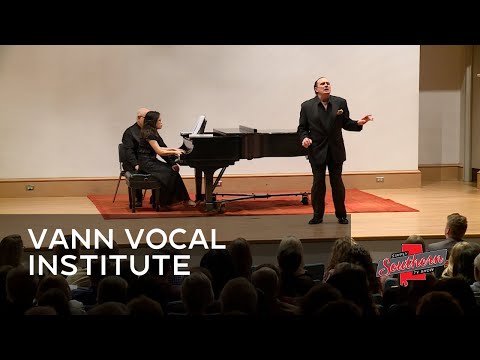
As some of you know, in addition to my operatic performance career, I have spent the last five years establishing (by invitation) a small but growing vocal institute in Montgomery, Alabama; a city with which I have had a decades-long association.  As the Artistic Director of the Vann Vocal Institute (named after deceased philanthropist and classical voice enthusiast Roy D. Vann of Montgomery, AL), it is my mission to bring some of the finest coaches, singers, directors, conductors, artist managers, and artistic administrators to the fine Capital City of Alabama.  The Institute caters to students from the State of Alabama, and takes place on the beautiful campus of Huntingdon College.  The upcoming weekend of March 1-4 (with the bulk of the hands-on work being done on March 2/3) is certain to be intense, with coaching talent from the Metropolitan Opera, Lyric Opera of Chicago, and artists with an international-experience platform at the forefront.  ‘Yours truly’ (as I regularly refer to myself) will also play a large part in the festivities by providing a continuous main-stage masterclass over the course of our weekend.

Students pay only a modest application fee, but receive first class instruction and lectures from our Artistic Staff and Advisory Board (most of whom are active educators and performers themselves).  Due to popular demand we have had to add additional coaches and lecturers to accommodate the over 50 students that are accepted via submitted audition CD’s.  The weekend culminates in an on-the-spot “Emerging Artists” public recital program; the participants of which are chosen via consensus by myself and the rest of the Artistic Staff.  This year we are pleased to announce that substantial cash prizes will be awarded at the finale of our Emerging Artists recital.   Long before the students arrive, however, is the planning process–which is nothing short of daunting!  Without the dedicated assistance of the Administrative and support staff of the Montgomery Symphony, the VVI Advisory Board, and the cooperation of Huntingdon College, this event would never take place.

Audition CD’s must be screened, participants chosen and contacted, additional accompanists contracted, schedule matrices developed, programming determined, housing and meals arranged, social events planned, novelties ordered, photographers organized, ground transportation sorted; etc, etc, etc.  All of this, and more, must be accomplished on a tick-tight budget that allows for very little error.  We have been fortunate that another local enthusiast of our program will dispatch his very first-class, (right out of the movies) private jet to NYC and Chicago in order to fly our staff and ‘yours truly’ down to Montgomery yet again!!! This same donor (name purposely withheld) has also arranged for housing at the local Country Club for our coaches and visiting dignitaries, while still others open their homes for dinners and parties in this oh-so hospitable southern town.  These high end donations are true cost-savers and have enabled us to meet our budget for the past few fiscal years.  I am also proud to have brought aboard another major foundation donor which, along with grant dollars from the State (determined annually, but getting difficult to secure), will allow us to operate uninterrupted for several “out years”.  (More on this major donor at a later date, but suffice it to say that it’s Executive Administrator will be joining us for this year’s installment.)

The core of our instruction is in the classical art of singing (opera and song), with occasional Broadway included, as we have students who range from the mid/late teens through to University-level age groups.  Students travel many miles to access this program, while some come from the local area; with students from Alabama State and Huntingdon College itself also represented.  If the past is any harbinger of the future, then this year will surely be something to look forward to.  In all, these students arrive extremely well prepared, respectfully dressed and behaved, and ready to learn.  They hang on every word, take notes, ask great questions, and have obviously learned well from their local area instructors.  This program is popular because most of these well deserving students rarely come into contact with the type of first-rate, international level instruction locally that we provide.  In short, we bring the program to them, instead of them having to get to a program (ie. Tanglewood, Interlochen, Aspen, etc.).

To be clear, I am not in any way trying to compare the Vann Vocal Institute with the above mentioned music programs/festivals overall.  But I am absolutely confident that if we were not able to provide what we do for these truly excellent students, then many of them would never get the accelerated stewardship that they will receive in Montgomery, Alabama this year!

So thank you Charlie, Helen, Tom, Michael, Gene, Pamela, Mary, President West, and of course, Miss Bettie!!  And so many others that I have not mentioned; or, for contractual reasons, cannot mention at this time….

As a matter of good order, I insist that all students send the music they will present to me onstage in the master-class portion of the weekend.  It is unfortunate that my “Chief of Staff” (Helen) must often light fires underneath some students to get their music submitted to us on time; while others are professionally prompt.  The reason I ask for these materials is because I have such little time with each student (30 minutes), I often pre-mark the music for what I believe are matters that I will potentially have to address.  But additionally, I sit at my piano for one solid week ahead of time and sing through each and every piece that will be presented to me…(singing some better than others, to be sure!!).  It is important, I believe, to know what each student is going through, especially in repertoire that might not be my specialty.  So make no mistake…it is work, work, work, leading up to, and right through the entire weekend!!!

My musical staff and I are Montgomery bound, and simply cannot wait to once again spend some time in what I have dubbed the “friendliest city on earth”!

djc

COC’s “Love from Afar”: The joys and challenges of contemporary opera!

February 6th, 2012

This past weekend, a friend and I attended the other current offering at Canadian Opera Company; Kaija Saariaho’s Love from Afar, based on the 12th century poetic text La Vida breve by Jaufre Rudel, with modern libretto by Amin Maalouf, and stage direction by Daniele Finzi Pasca.  As the “Hollywood-ization”–or in this case the “Cirque du Soleil-ization”–of opera continues, there is much to herald and much to ponder regarding its continuing challenges.

First off, this opera–as fashioned from its original source–clings to a very simple and thin storyline:  Troubadour Jaufre Rudel, bored with his life of excess in France, dreams of the perfect love.  Such love (in the form of the character Clemence) is to be found in far off Tripoli thanks to critical information provided by a frequenting Pilgrim.  The two are made aware of one another, and the longing begins.  The troubadour travels to Tripoli, and en-route becomes shattered by anxiety like an eggshell underfoot; remaining intact, but by only the thinnest of membranes.  He becomes ill, and although the couple never consummate their love physically, they do so spiritually before he expires, leaving Clemence to end the opera in a sort of Isolde-esque state of being.

To say that COC has provided this opera with a first rate production would be the understatement of the second decade of this new millennium.  On all fronts, this was a stunner: incredible lighting, fantastic costumes, the most inventive of high-tech digital projections, acrobats, dancers, flying silk, 30 hand held mirrors (which I mistook for a bunch of iPads on-stage…well, ‘who knows’ these days???!!!), principal artists in triplicate (2 additional mimes for each character), and a vocal cast that represented the most superb singing that one could hope for!  So what’s the problem???  I am not really sure, to be quite honest!!!

It struck me that such an unaffected storyline, minimal character development (a characteristic of the work itself, not the talent), even less dramatic action, and the somewhat monotonous vocal music would probably need such over-the-top accoutrements to keep it interesting.  But too often, my focus began to wander from the singers themselves in an attempt to unearth the meaning behind the twirling silk, acrobatic back-flips, the very strange presence of a young ‘American Gothic’ couple throughout the production, and everything that is now textbook Cirque du Soleil (in the sense that we understand it as part of the popular lexicon).  At the very same time, however, I was totally mesmerized by a moment of silence where, with backs to the audience, the characters of Rudel and The Pilgrim look out over the expanse of open seas (courtesy of an incredible visual projection over stage scrim) with the brightest of moons in the far distance; as well as their journey through time and space as they walked across a geometric rendering of the galaxy (again, courtesy of suspended aerial artists that were hung on their sides as they “walked”; similar to Loge and Wotan’s descent into Nibelheim in the Met’s new Rheingold).

Ultimately, all I can say with absolute certainty is that the whole of this overall production was certainly greater than the sum of its individual parts.  Much needs to be said about Johannes Debus’ conducting of the incredibly interesting and difficult orchestration, as well as kudos to the musicians themselves who executed it.  An interesting use of a mostly offstage chorus led us to believe that a larger cosmic force was observing all of the worldly action, as they regularly commented on it.  Ultimately, however, opera is about the singers; and COC provided three of the finest: Baritone, Russel Braun (Jaufre Rudel);  Soprano, Erin Wall (Clemence); and Mezzo-Soprano, Krisztina Szabo (a rather ‘Kundry-like’ Pilgrim).  All were nearly flawless in delivering moments of great nuance when provided to them compositionally; and oddly enough, Ms. Szabo was equally compelling when she was simply observing the interactions between the characters of Rudel and Clemence…providing, in a sense, the ‘apex’ of triangulation as the opera’s main protagonist.

Finally, we have seen these big budget, high risk/high reward productions regularly on the opera stage these days:  The Metropolitan Opera’s recent Damnation of Faust and current Ring Cycle; Dallas Opera’s Moby Dick; everything Bregenz Festival, and of course many, many others throughout the world.  Modern audiences seem to expect more and more in the area of stage presentation, and are often left gasping as they leave the opera house; while time-honored opera goers scratch their heads and wonder why??

That’s the best post-performance show in town; and you gotta love it!!!

djc

When a “Fantasy” becomes reality…(LOC’s ‘Fantasy of the Opera, 2012′ takes center stage)

January 29th, 2012

If one ever wonders what happens when a bunch of opera singers meet well dressed donors under a themed evening of glamor, drinks, dinner/dancing, and a cabaret performance where anything BUT opera is performed; they need go no further than the Lyric Opera of Chicago to find out.  Once a year, Chicago’s finest and ‘fun-est’ attend the company’s famed “Fantasy of the Opera” Gala, which held it’s annual fete this past Friday (January 27, 2012).

For 28 years the opera company–but more specifically, it’s Guild Board of Directors–has put on this Gala as it’s most highly anticipated fund-raising event of the season.  It is, in my estimation, even more coveted an occasion than the celebrated Opera Ball that I have written about just recently (see my posting: “When Life Interrupts”).  There are three reasons for this: fun, Fun, and FUN.

Sure there are gowns and tuxedos, photographers and media; food, food, and more food; as well as the finest champagne and spirits money can buy.  There are also valuable raffle prizes, a variety of silent auction offerings which are bid on via a state-of-the-art electronic bidding process, and a great society band/orchestra that allows revelers to dance the night away.  The Lyric usually makes about $500,000 on the event, but the actual tally is always posted as a result of local newspaper and/or society page coverage the following week.  But what sets this party apart is the now legendary “Cabaret” performance that is given by the Stars of the Lyric Opera–this is where the FUN part of ‘fun, FUN, FUN’ comes in!!

As a result of having performed on this event some 16 years out of 28 (yes, I hold the record for the most appearances by any one artist), as well as hosting it twice, I can tell you that we singers look forward to it as much as any of the guests.  (I flew in from Toronto this year, especially for the occasion.)  There is no ‘pressure’ at these performances; the management wants us to have as relaxed a time as the attendees.  And over the years, I have seen the biggest stars of our industry just let their hair down and sing the great standards, show-pieces, country music favorites, national specialties, Broadway show tunes, jazz classics, torch songs, barber shop quartets, and even some rock-n-roll.  What the heck…it’s all about FUN, right???

I’ve watched gowned operatic super-stars fall flat on their face (literally) when their shoe heel catches their hemline, while others have taken to the stage to hoe-down when the timing seemed right; some have tripped or slipped as they entered or exited, some told jokes that bombed (like me) or left them howling (like me); high notes are blown, while others are spectacularly executed.  None of it matters really…because we are there just to enjoy…whether we sing a ballad/love song, or just a silly rendition of Don’t Fence Me In.

It is good to blow off some steam, not take ourselves too seriously, and assist in raising desperately needed funds for what I have always termed the art-form of all art-forms.  But it must also be noted that so many of our Guild Board members work for an entire year to make this one-night-extravaganza as important as any full-run opera production.  This year may have been one of the best, although they are always spectacular!  And as far as variety of cabaret performances go; there were no less than 14 performers that included Nathan Gunn, Amber Wagner, Emily Fons, James Kryshak, Jamie Barton, Philip Kraus, Susanna Philips, Morris Robinson, Alyson Cambridge, Rene Barbera, Elza van den Heever, and others still–including ‘yours truly’.  Maestro Craig Terry provided spirited accompaniment for all, while Lyric’s new General Director, Anthony Freud donned a cowboy hat and hosted as the Master of Ceremonies.

For the record, I rewrote the lyrics to Billy Joel’s Piano Man specifically for the event to honor “All things Lyric”.  I even got the audience to sing along, as I coolly sipped a “scotch on the rocks” on-stage!!  You see; after 16 years I know the temperature of our Chicago audiences pretty well, and see many a regular in the crowd each season.  If only I hadn’t needed to fly out the very next day…well, let’s just say the party may have continued at my home, which it has in years past!  Maybe we will do it next year–if I am invited back…although I am running out of party pieces!!!

djc


“Afternoon Delight”…a COC regularity!

January 17th, 2012

On this cold, foggy, but rainy Toronto Tuesday, in the midst of a winter that won’t make up its mind; the Greater Toronto Area (“The GTA” to us regulars…ha, ha…not really a regular…but I just couldn’t resist) had the opportunity to shed a few pounds over their lunch hour.  That is to say, instead of filling their stomachs, they could fill their souls instead, with a full helping of interesting musical/artistic fare–courtesy of a Free Concert Series in the Richard Bradshaw Amphitheatre of The Four Seasons Centre for the Performing Arts.  These free concerts and dance events focus themselves on six different areas of the performing arts, with today’s installment (Tuesday January 17, 2012) being that of the ‘Vocal Series’.

As rain droplets pocked the pavement below, and umbrella tops provided their own brand of pre-concert entertainment, an overflow audience perched itself on the third floor bleacher seating of the dramatic, glass-encased lobby amphitheatre, as others lined the fourth floor standing gallery and looked down.  They were treated to a program entitled In Praise of Women, which featured the long overdue, too long ignored, contributions of female composers to the musical firmament, along with texts by different poets of their day.  The program was performed by members of Canadian Opera Company’s “Ensemble”, or Young Artists Program…more on that later (and a pet-peeve about it!).

With appropriate spoken commentary that preceded some of the individual pieces–and some humorous anecdotes about the plight of the female composer as an entity–the assembled vocalists and their accompanists distinguished themselves by any and all critical measure.  While most will not recognize any of the singers by name (yet), and in most cases will not recognize the composers (Alma Mahler notwithstanding), all in attendance left more fulfilled, more entertained, and more educated than before they entered.

Soprano Mireille Asselin set the tone with an ethereal O Virtus Sapientiae by 10th Century composer Hildegard von Bingen, followed by the duets In der stillen Mitternacht, and So soll ich dich verlassen by Fanny (Mendelssohn) Hensel…whose own work was often attributed to her brother Felix!!  Ms. Asselin, Neil Craighead (bass-baritone), Ileana Montalbetti (soprano), and Christopher Enns (tenor), all acquitted themselves admirably in these rather dramatic and plangent pieces.  Mr. Craighead followed up with a vocally solid and polished Chanson triste and Reve d’un soir by Cecile Chaminade; while Mr. Enns delivered an earthy, well sung set of songs by Alma Mahler.

The crowning achievement of the afternoon, however, had to be Soprano Jacqueline Woodley’s 13 minute masterful exposition of Judith Weir’s King Harald’s Saga.  Armed with only a pitch-pipe, Woodley delivered the very angular, part narrated, part declamatory, part fioratura, chain of events about a Norwegian King’s ill-fated invasion of historic Yorkshire, England.  This piece, composed of three ‘acts’ and epilogue, required Woodley to create several characters (including a sort of Greek Chorus), utilize several characteristic voices, and act with only the help of an armchair; again, all without accompaniment.  She dispatched the devilishly difficult coloratura with absolute pinpoint accuracy and fully convincing characterizations throughout.  She riveted the crowd with her eyes and dazzled them with her vocal prowess.  This particular work can be Ms. Woodley’s recital tour de force for quite some time, should she so desire.

Rounding out the program was Ileana Montalbetti’s rendering of Donal Oge (Young Donal), Libby Larsen’s “aria in search of an opera”.  Montalbetti gave this anthem of ‘stinging rebuke’ a full-throated Canadian premiere, and charmed the audience with an experienced preface–having recently worked directly with the composer herself.  Jenna Douglas and Timothy Cheung provided fluid, delicate, and meaningful accompaniment throughout this program.

Finally, before I am accused of “puffing” this concert series, the COC ensemble members, or Canadian Opera Company in general; let me assure you that I do not know ANY of the singers (with the exception of Mr. Craighead, with whom I am currently working); I have barely exchanged words with the accompanists; and I hardly know this company.  But for the sake of full disclosure, I AM currently involved in a production of Tosca which will open on Saturday, January 21 2012.  Today, however, I was just another audience member sitting rather anonymously amongst the regulars who attend these concerts.  I did not identify myself, and was forced to study my program and its translations like any other concert goer.  In that all of the selections were new to me, I had to truly concentrate on the content of the offerings and am now merely reporting the proceedings exactly as I witnessed them.

Now to that little “pet-peeve” I mentioned earlier:
For years now I have been a guest member of audiences in various cities where I have worked world-wide, and have attended numerous concerts/recitals provided by ‘Young Artists’ under the auspices of a home Opera Company.  I, in fact, participated in such a program at the legendary Lyric Opera of Chicago many years ago (LOCAA then, The Ryan Opera Center now).  I have forever heard of them being referred to as “professional training programs”, or “opera schools” by their own administrators and members of the media.  Today’s description was “prestigious professional training program”.  While I am always prepared to accept the adjective of “prestigious” when attached to companies such as The Met, COC, Paris Opera, San Francisco Opera, HGO, and the aforementioned LOC; I do think it is time to drop the mischaracterization-terms of “training program” and “school”.  If today’s talent was any indication, these artists may be YOUNG, but they are hardly in need of ‘training’, as it were.  These young ladies and gentlemen displayed the grace of finished, competent artists of high caliber and true lasting potential.  They have been brought to these major opera companies to be given bona-fide, legitimate, on-stage experience on an international scale.

Therefore (even though I realize that I am getting very picky here), may I respectfully suggest that we weave into the public narrative this descriptive:  Professional Experience Program.

It’s just a thought, of course…

djc


COC: The most interesting Opera Company in North America???

January 3rd, 2012

During a recent industry related conversation, one of opera’s most informed insiders intimated to me that Canadian Opera Company (COC) would, “in five years’ time, become the most interesting (opera) house in North America.”  While it is not likely for me to question the authority of this source, I found the words of Ronald Reagan (politics aside) ringing in my head…”Trust, but verify”.  Our late President used this phrase often as he dealt with his Russian counterpart, Mikhail Gorbachev, with regard to the INF Treaty of 1987.  And if it was good enough for him (btw, Lenin used it too!), it was good enough for me to keep in the back of my mind.

It didn’t take too long, however, for me to realize that COC was/is at it’s core a most intriguing organization.  While hardly in its true infancy at over 60 years old, respectively; COC feels young.  They rehearse and administrate from a daring facility that has seen as it’s former lives (late 19th and early 20th century), a Textile Mill, a Gas/Oil concern, and a Maraschino Cherry factory; but converted–via technical and structural build-out–to a full fledged operatic operations center.  Its red brick walls, giant maroon shutters, wooden/bolted ceiling trusses, and large warehouse windows are perfect host companions to this art-form of all art-forms; as we rehearse the more classic Tosca juxtaposed against a far more contemporary Love from Afar (L’amour de loin).

The staff and administration (headed by Alexander Neef–General Director, now only in his late 30′s, and Johannes Debus–Music Director, mid 30′s)  are vibrant, but also unusually experienced on an international scale.  Filling the shoes of the likes of Lotfi Mansouri, Brian Dickie, and Richard Bradshaw cannot be easy (the latter in particular); therefore a company of this stature, with a very new performing arts center, and a loyal audience, for certain, needs forward thinking and energetic personnel.  This characteristic doesn’t begin and end with the front office, however.  My recent costume fitting was as thorough and creative as any I have experienced at the famed Metropolitan Opera, Paris Opera, San Francisco Opera, or Lyric Opera of Chicago (just to name a few respected venues with whom I have had multiple experiences), the stage management seems prepared for all occurences, the company employs a female chorus master (something you do NOT see everyday in this business), while the Artistic Administrator(s) are forever “putting out fires” (something you DO see everyday in this business!!).

The artistic planning is both bold and traditional…a high-wire that every opera company must walk with special care these days.  While taking the economy into account, attempting to broaden their gallery, and still appeal to the press; outreach is a priority, and so is energy and innovation.  What else would one expect from the first opera company to employ the use of supertitles for the benefit of their audience??…and that was almost 30 years ago!!!

The most interesting (opera) house in North America?”  We shall see; but don’t be surprised…the source I mentioned in the first sentence of this posting has rarely been wrong.  So I will trust for now, and verify later!

djc

How I Miss the Christmas Music (and the ‘Magic’)!!

December 8th, 2011

For so many of us in the classical vocal arts, one of the prime directives that we give ourselves early on is to strive to become a soloist, or principal artist, in the industry.  It is a long, hard, scary, and extremely lonely road.  Once achieved–if achieved, comes a whole host of new problems attached to that status: long-term viability, “flavor of the month” complex, vocal health concerns, sex-appeal sustainability, repertoire shifts, ego/self esteem issues, and sometimes the need for moment-to-moment validation (in extreme cases).

There are periods, however, when we also look back to “simpler times” when we were still in striving mode, and a wistful smile usually crosses our face.  For those were the times when we were also struggling to “survive”; that is to say…pay for school, get our studies done on time, work two or three jobs, pay our rent, hope that our usually crappy cars didn’t require an expensive repair, etc, etc, etc; and of course, worrying about the next audition or competition!  Along that vein ran the need for many of us to sing in church choirs, usually with the obligatory Thursday night rehearsal, or an extra-early Sunday morning appearance (or both) to earn money, while plying our craft a bit at the same time.  At this time of year–Christmastide–we were often presented with a wide range of holiday music that was certain to touch many souls no matter how trite or sophisticated.  Olde English Christmas Madrigals, simple Christmas Carols, the Christmas portion of The Messiah, or Bach’s Christmas Oratorio, all hold special places in people’s hearts.

At the Old South Church in Boston, where I sang for a few years while studying at Boston University, we were told up-front that in order to accept the job (which paid well as far as church jobs go…and did NOT have a Thursday night rehearsal) we had to be available to sing the late Christmas Eve service–no Ifs, Ands, or Buts; as Fred MacArthur (the music director at that time) didn’t fool around.  The result was nothing that ever fell short of pure Christmas magic.  A stunningly beautiful church, a dignified service, and the most beautifully programmed choral music I think I have ever consistently sung.  When the service ended, everyone walked out with a sense of peace and loving security, including–or perhaps especially–those of us who sang this wonderfully composed/arranged music.  We knew that we contributed mightily to the enjoyment of the service as a collective…not as a star soloist, but ultimately, just as a humble musical participant.  It felt really good; but as the years pass, many of us no longer participate in church choirs, or gathered vocal ensembles…much of it having to do with our need to move around from city to city to earn a living.

But oh, how I miss singing that Christmas music, and the unassuming contribution I made to those ‘magical’ services as an ensemble member.  In a way, there was nothing quite like it!!

Merry Christmas and Happy Holidays,

djc

To Applaud, Or Not Applaud?

November 22nd, 2011

THAT IS THE QUESTION!!!!

When I performed in the 1970 Broadway musical Applause, (in 1985) at the Brunswick Music Theater in Brunswick, Maine; I must admit that I never would have imagined that I would ever script a commentary on just such a subject.  But as the lyrics to the title song ring in my head: “Why do we work our asses off? Applause, Applause…”.  I found myself pondering just that…

You see, a funny question was posed to me the other day following the Sunday matinee of Boris Godunov at the Lyric Opera of Chicago.  A member of the audience (a friend) was asking me what was up with all the applause coming from the performers themselves…”aren’t you supposed to be the ones getting the applause??”, he asked.  Good question, I thought; so I began to give it some consideration…

Old school protocol seems to reinforce the mindset that at curtain calls, the performers should gracefully receive the applause that they have earned for the performance they have just given, and refrain from applauding one another.  OK, I can understand and accept that to a certain extent, and also understand its reasoning.  But over the years there HAS been a tendency for performing artists to applaud one another as we take our curtain calls.  This normally happens when the curtain is “out”, and we enter from the wings to take our applause, as opposed to what we term “paged bows”, which is when the curtain falls, then is opened at the center by a Curtain Page–at which point we emerge in two’s, three’s, a group of five, etc;  and of course, the solo bow–all of which are effectively in front of the curtain.  The bows are all pre-arranged, and are indeed usually rehearsed so that they do not look sloppy.

I know for sure that for several years now, we on-stage performers have been so grateful to sing with a live orchestra, that we heartily applaud their efforts.  We therefore applaud for them when the conductor comes out to take his/her bow, and acknowledge the forces in the pit!  Keep in mind, they sit and play non-stop; especially rigorous is their task on those nights where Richard Wagner is on the menu!!  Remember if you will, that the live, true, operatic format (along with symphony, and ballet) still uses a full classical orchestra as accompaniment–or primary focus in the case of symphony, of course.

But back to the singers applauding themselves:  I for one, am always anxious to applaud my colleagues, and often do…even if it is two or three simple claps.  I guess it is because I know what it has taken to get to the point of even being able to take a bow.  Therefore, if I am guilty of breaking old-school protocol, then so be it…I am guilty, as charged.  Note also that when I take a bow, I sometimes applaud the audience!!  It’s my small way of saying “thank-you for coming!!”.

Then there is the special case scenario such as this (give me a second, I will get to it):

In our current production of Boris Godunov at the Lyric Opera of Chicago, we are lucky enough to have one of the great interpreters of the title role (Ferruccio Furlanetto) in our midst.  I have been honored to sing Boris Godunov twice in this year of 2011–once in Dallas with another outstanding artist, Mikhail Kazakov, in the title role (see http://www.davidcangelosi.com/boris-godunov-at-the-dallas-opera/), and now Mr. Furlanetto.  I for one can tell you (if you want to know what goes on “behind the scenes” sometimes) that all of the principal artists crowd into the “wings” to watch and listen to Mr. Furlanetto as he sings Boris’ death scene…the scene that, in this performing version, ends the opera.  It is no exaggeration to say that it is riveting, even as we watch from a side angle!!  Those who are lucky enough to view this scene from the full-on audience perspective, are especially gifted.  His is, in fact, the modern day gold-standard interpretation of the role; following in a not too terribly long line of great bassos who have sung this role to utter distinction.

When Mr. Furlanetto enters the stage to take his solo bow in front of all the chorus, supernumeraries, and other principal artists; the chorus shuffles, or lightly taps their feet, while we others applaud unabashedly…WE DO IT OUT OF RESPECT!!!!

A truly great artist is entitled to this from the audience AND his/her colleagues.  They have earned this kind of reception because of their many years of service to a large body of work, or for a particular role for which they have become synonymous!!!

I hope this helps to address the issue, and I appreciated the question.  It was a good one!!!

djc